How We Turned a Moroccan Travel Brand Into an International-Caliber Experience
10 min read · February 2026
There's a specific kind of failure that doesn't look like failure. The product is excellent. The customers who find it are transformed by the experience. The founder knows, with absolute certainty, that what they've built is world-class.
But the brand — the visual identity, the language, the website, the first thirty seconds of someone encountering it online — tells a completely different story. It says commodity. It says one-of-many. It says this is fine, when the truth is this is extraordinary.
Xquisite Morocco was that story.
The Client
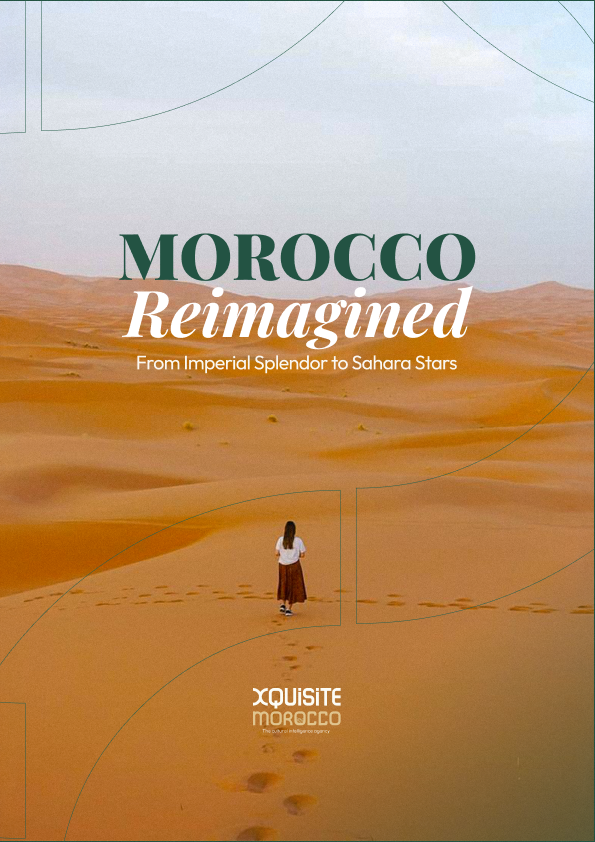
Xquisite Morocco is a luxury cultural travel company based in Casablanca. They design curated, multi-day journeys through Morocco — not tours, not packages, not itineraries pulled from a template. Each trip is built around cultural immersion: High Atlas mountain crossings, Sahara desert camps under open sky, private access to artisan quarters in Fès, evenings in riads that most tourists never find. The target traveler is affluent, typically American, typically between 35 and 60, and looking for something that changes how they see the world — not just a vacation.
The product, by any honest measure, was premium. The experience was genuine. The attention to detail — from sourcing guides who could narrate the interfaith history of the Mellah to arranging sunrise camel treks in Merzouga timed to specific wind patterns — was the kind of care you find at the very top of the luxury travel market.
None of that was visible in the brand.
The Problem
When we first reviewed Xquisite Morocco, we saw what any prospective traveler would see: a website and visual identity that was indistinguishable from dozens of other Moroccan tour operators. The same sunset photography. The same serif-on-sand aesthetic. The same language about "unforgettable experiences" and "authentic culture" that every operator in the region uses.
The specific failures were structural, not cosmetic. The visual identity had no system — colors, fonts, and imagery shifted from page to page without a governing logic. The photography direction leaned on stock-style landscape shots that could represent any North African destination, not specifically Morocco and certainly not the singular Xquisite point of view. The website read like a brochure rather than an experience. And the language — the way the brand spoke about itself — competed downward, positioning Xquisite among budget and mid-range operators instead of against international luxury experience brands where it genuinely belonged.
The result was a pricing mismatch. Xquisite charged premium rates because the experience justified premium rates. But the presentation whispered commodity. Prospective travelers who found the brand online saw the price, compared it to the visual impression, and moved on. The brand was losing to less capable competitors who simply looked more expensive.
This is what we call the Invisibility Tax. Not the cost of being unknown — the cost of being seen and dismissed. The product was better than the brand made it look, and every day that gap persisted, revenue walked out the door.
The Process
We didn't start with design. We didn't open a mood board or discuss color palettes. We started with the business.
Three intensive workshops over two weeks. The first focused entirely on the business model — how Xquisite Morocco actually made money, where the margins lived, what the client acquisition path looked like, and what the lifetime value of a customer was. We weren't designing a logo. We were mapping a business so that every brand decision downstream would serve a commercial purpose.
The second workshop was about positioning. We studied the competitive landscape — not just Moroccan operators, but the international luxury travel brands that Xquisite's actual audience was comparing them to. Companies like Abercrombie & Kent, Black Tomato, and Remote Lands. That's who Xquisite's audience was evaluating. And that's who the brand needed to stand beside, not above and not below — beside. As equals with a different proposition.
The third workshop focused on the customer. We conducted primary research with the actual target audience: American travelers who had either visited Morocco or were considering it. We asked what drove their decisions, what made them hesitate, what language resonated, and what turned them off. The findings reshaped everything.
Three patterns emerged from the research. First, the word "tour" was a liability. The target audience actively avoided anything that felt like a tour. They wanted to discover, not to be herded. Second, visual signals mattered more than copy. Within seconds of landing on a travel site, these travelers had already decided whether the company was "for them" — and that decision was driven almost entirely by photography, typography, and the overall feeling of the digital experience. Third, the strongest emotional driver wasn't relaxation or adventure. It was transformation. They wanted to return home changed. Different. Having seen something most people never see.
That third insight changed the direction of the entire project.
The Insight
Every Moroccan travel brand we analyzed — every single one — positioned itself as a provider of experiences. See the Sahara. Visit Fès. Stay in a riad. Explore the souks. The frame was always: here is a beautiful place, and we will take you there.
Xquisite Morocco had a different truth. Their trips didn't just show people Morocco. They changed the person who took them. Travelers came back with a deeper understanding of Berber culture, of the intersection between Islam and Judaism in Moroccan history, of how architecture reflects geography and belief. They came back not as tourists who had visited Morocco, but as people who now carried a piece of Morocco's intellectual and spiritual depth with them.
We inverted the competitive frame. Instead of selling a destination, Xquisite would sell a transformation. Instead of competing on itinerary quality, it would compete on what the traveler becomes. The positioning line that emerged from the workshops captured it precisely: "The only luxury travel experience that turns sophisticated travelers into guardians of ancient wisdom."
This wasn't a tagline exercise. It was a strategic repositioning that would govern every decision that followed — visual identity, photography direction, website architecture, copywriting voice, and pricing structure. The brand would no longer explain what Morocco looks like. It would demonstrate what Morocco does to you.
We gave this positioning a name: Intelligence Tourism. Travel designed not around sightseeing, but around understanding. Not around comfort, but around depth. A category that no competitor occupied because no competitor had thought to define it.
Four non-negotiable brand values were established as the foundation: Authentic — nothing staged, nothing performative, every experience rooted in real Moroccan culture. Refined — the execution, from accommodation to guides to communication, would meet international luxury standards without ever feeling sterile. Intelligent — every touchpoint would assume the traveler was curious, well-read, and seeking substance. American-Centric — the audience was primarily American, and the brand language, references, and user experience would be calibrated to how Americans discover and evaluate luxury travel.
The Transformation
With the strategy locked, we built the system.
A 30-page brand guidelines document delivered the complete visual and verbal identity. Not a loose collection of logo files — a comprehensive, opinionated system that governed how Xquisite Morocco would look, sound, and feel across every medium.
The visual identity was built around a palette of Deep Jungle Green (#285F4C) as the primary brand color — a color that carried weight, sophistication, and an organic connection to Morocco's landscapes without resorting to the predictable reds and golds of the tourism category. Supporting colors included Linen White, Antique Gold, and Champagne Beige — each chosen to signal understated luxury rather than decorative excess.
Typography was anchored by Outfit, a typeface that reads as clean and modern at display sizes but retains warmth and approachability at body copy sizes. It was selected specifically because it doesn't look like a luxury travel font — it looks like a brand that's confident enough not to rely on visual clichés.
Over 40 custom icons were designed to replace generic stock iconography across the website and collateral. Each icon followed the same visual language — consistent stroke weight, rounded terminals, a style that felt hand-considered rather than pulled from a library. These icons covered everything from itinerary waypoints (mountains, kasbahs, dunes, medinas) to service details (private guides, luxury accommodation, curated dining).
Photography direction shifted from landscape-first to human-first. Instead of sweeping desert panoramas with no people in them, the new direction prioritized travelers in context — interacting with artisans, walking through narrow medina passages, sitting in silence with a guide overlooking the Dades Gorges. The camera moved closer. The color grading moved warmer. Every image was required to answer the question: what does it feel like to be here? Not: what does this place look like from far away?
The brand language guide established a voice that was knowledgeable without being academic, inviting without being casual, and premium without being cold. Specific words were flagged for avoidance — "tour," "package," "deal," "excursion," "itinerary" (replaced with "journey"), and any language that framed the traveler as passive. The traveler, in Xquisite's language, is always the protagonist. Morocco is the catalyst. The brand is the guide.
The Execution
The website — xquisitemorocco.com — was rebuilt from the ground up. Not redesigned. Rebuilt. The previous site functioned as a digital brochure: here are our trips, here are the prices, here is a contact form. The new site was designed as a sequential experience that mirrored the emotional arc of the journey itself.
The homepage opens not with a list of itineraries but with a statement of identity: what kind of traveler this brand is for and what kind of transformation awaits. The itinerary pages are structured as narratives, not checklists. Each journey is told as a story — day by day, with context about why each stop matters, what the traveler will understand after visiting, and what connects one location to the next. The route from Marrakech through the High Atlas to the Sahara isn't presented as logistics. It's presented as a progression from the known to the unknown, from the urban to the primal, from observation to immersion.
A journal section was built to house long-form content — deep explorations of Moroccan culture, history, and spiritual traditions. Articles like the history of the Hamsa in Judaism, the cultural significance of the hammam, and the architectural heritage of Morocco's imperial cities. This content serves two purposes: it demonstrates the intellectual depth that defines Intelligence Tourism, and it captures search traffic from travelers in the early research phase who haven't yet decided which operator to use.
Every touchpoint was unified. Social media templates, email headers, booking confirmation documents, physical welcome packets for travelers arriving in Morocco — all built from the same 30-page system, all speaking the same language, all projecting the same identity. A traveler who discovers Xquisite on Instagram, visits the website, receives a follow-up email, and then arrives at the riad in Marrakech should feel that they're interacting with one coherent entity at every step. That consistency is what separates a brand from a business with a logo.
The Results
The repositioning produced measurable outcomes within the first six months.
- 3× pricing power. The average booking value increased to three times the category average for Moroccan luxury travel operators. The presentation now matched — and in many cases exceeded — the perceived value of the experience itself. Prospective travelers who landed on the new site understood, within seconds, that this was not a standard operator. The price felt justified before a single itinerary was read.
- +184% revenue lift. Total revenue grew by 184% in the six months following the brand launch. This wasn't driven by increased advertising spend. It was driven by a higher conversion rate on existing traffic and a significant increase in referral-driven bookings — travelers who had experienced Xquisite recommending it to their networks, now equipped with a brand that was easy to share and impressive to receive.
- 30+ page brand system delivered. The guidelines document became a living operational tool, not a PDF that sat in a folder. It governed hiring decisions for new guides, photography briefs for seasonal content shoots, and partnership evaluations with hotels and experience providers. The brand system didn't just describe how Xquisite looked — it described how Xquisite thought.
A new category established. "Intelligence Tourism" didn't exist before this project. Now it defines how Xquisite Morocco communicates, differentiates, and sells. No competitor occupies this position because no competitor has the strategic foundation to claim it authentically. The category isn't just a marketing angle — it's embedded in the product design, the guide training, the content strategy, and the customer experience. It's defensible because it's real.
What This Means for You
Every brand has a version of the Xquisite problem. The gap between what the product actually is and what the brand makes it look like. The gap might be smaller or larger, but it exists — and it's costing you something every day it persists.
The question isn't whether your product is good. If you've read this far, it probably is. But in sensitive categories — whether luxury travel or mental health — trust is the gatekeeper. The question is whether your brand is making people believe that before they experience it.
If you're not sure, there's a way to find out.
See where your brand actually stands.
Take the Remarkability Score — seven questions, four dimensions, 90 seconds. No email required.
Keep Reading
Why Moroccan Products Struggle to Look Premium
92% of products on the shelf share the same visual language. Here's why that happens and what the 8% do differently.
The Invisibility Tax: What Generic Branding Costs You Every Month
Your brand isn't free. Invisibility has a compounding price — in lost customers, suppressed pricing, and a category position someone else fills.