YASHUDD: How We're Reinventing Real Estate for the Digital Family
12 min read · February 2026
The Number That Broke the Category
330 million.
That is how many people worldwide now work remotely, either fully or in a hybrid arrangement. Nearly 80% of employees whose jobs can be done remotely are working either hybrid or fully remote. The telework rate in the United States has held steady between 18% and 24% since late 2022, and the global trend line is not retreating. Remote work is not a phase. It is an economic restructuring.
And here is the number that no one in real estate is talking about: 26% of American digital nomads now travel with children. That is one in four. The estimated global population of digital nomads reached 40 million by 2025, roughly doubling from pre-pandemic levels. A growing percentage of them are not solo laptop workers drifting between hostels. They are families. Two parents. Two or three children. A business to run. A curriculum to follow. A life to build — not in one place, but across many.
The Guardian documented this shift in December 2025, reporting on the rise of "worldschooling families" — parents who combine remote work with global education for their children. The Times followed with profiles of families who had visited 19 countries in a single year. The infrastructure they describe — co-working cafés, Airbnb apartments, borrowed desks in shared spaces — is universally improvised, universally inadequate, and universally designed for someone else.
Nobody has built a home for this family. Not a hotel. Not a co-working space. Not a serviced apartment. A home. One that understands that a parent needs a video-call-ready office ten steps from the kitchen. That a child needs a learning space that is neither a hotel room nor a café corner. That a family needs private outdoor space, reliable connectivity, and proximity to community — and that all of this needs to exist in a place worth living in, not just passing through.
That is the gap YASHUDD was designed to fill. And it is the gap that Xperience Hub built the brand to own.
The Client
YASHUDD is a Marrakech-based residential development conceived to create a new category in real estate: adaptive housing for digital families. The project is not a co-living space. It is not a hotel. It is not a gated compound for expats. It is a residential product — architecturally designed, strategically positioned, and brand-engineered from the ground up — for families who have decoupled work from geography and need a home that reflects that reality.
The founding team came to us with a clear conviction: the global remote work shift had created a market that no real estate developer was serving. They had land in Marrakech. They had architectural ambition. What they did not have was a brand, a market position, a visual identity, a customer acquisition strategy, or a language for what they were building. They had a product concept. They needed it to become a category.
The Problem
The challenge was not architectural. The founding team had strong instincts about the physical product: flexible floor plans, integrated workspaces, children's learning zones, communal spaces, fast fiber connectivity, and a design language that merged contemporary North African aesthetics with the functional requirements of a live-work-learn environment.
The challenge was perceptual. YASHUDD existed in a no-man's-land between established categories. It was not a traditional riad — the Marrakech real estate market's default product, designed for vacation, not habitation. It was not a serviced apartment — too permanent, too integrated, too architecturally ambitious. It was not a co-living space — too private, too family-oriented, too rooted. And it was not a conventional residential development — too specialized, too narrative-driven, too deliberately designed for a specific way of living.
When something doesn't fit an existing category, the market doesn't know how to price it, evaluate it, or trust it. The customer cannot compare it to anything. The investor cannot benchmark it. The press cannot describe it without a reference point. Category ambiguity is the fastest path to invisibility in real estate, where purchase decisions are among the highest-stakes, highest-anxiety decisions a person makes. If a buyer cannot instantly understand what YASHUDD is — and more importantly, what it is for — they will not engage. They will default to a category they already trust.
This was the core brand problem: YASHUDD needed to become an obvious category before it could become a desirable product.
The Process
We ran the full Xperience Hub strategic engagement: three focused workshops over six weeks, each building on the previous.
Workshop One: Market Architecture
We mapped the landscape that YASHUDD would enter. The Marrakech real estate market is experiencing significant momentum — foreign investment in Moroccan real estate surged 55% between 2024 and 2025, with luxury property sales up over 12% year-over-year. Property prices in Marrakech range from 15,000 to 50,000 MAD per square meter depending on district and type. But the entire market is organized around two buyer profiles: the vacation buyer (seeking a riad or villa for seasonal use) and the local buyer (seeking conventional residential property). Neither profile matches the digital family. The vacation buyer wants beauty and proximity to the medina. The local buyer wants value per square meter and school access. The digital family wants neither of these things. They want a workspace-integrated home, community infrastructure for children, fiber connectivity as a non-negotiable, and a location that offers lifestyle richness without requiring a car. No existing development in Marrakech — or, as far as we could identify, in any comparable North African market — was built for this profile. The white space was not small. It was the entire territory.
Workshop Two: Customer Deep Dive
We researched and profiled the digital family in detail. The composite buyer is 32–45 years old, earns $80,000–$200,000+ per year from remote work (the average digital nomad earns between $50,000 and $123,000 annually, but family nomads skew higher due to dual-income households), has one to three children between the ages of 3 and 14, and is either worldschooling or using online school programs. They have lived in two or more countries in the past three years. Their primary anxieties are not about price — they are about stability without stagnation, connectivity without isolation, and community without the constraints of a traditional suburb. They want a home that feels permanent enough for a child to have a routine, but flexible enough that they are not locked into a 30-year mortgage in a place they might outgrow. Critically, this buyer makes decisions based on identity alignment, not just real estate metrics. They are not buying square meters. They are buying a vision of how their family lives. The brand must sell the vision before the floorplan.
Workshop Three: Positioning and Category Creation
This was the decisive session. We needed to define what YASHUDD is in one sentence — and that sentence had to create a new mental category. The existing category labels all failed. "Co-living" implied shared kitchens and twenty-somethings. "Serviced apartments" implied transience. "Residential community" implied gated conformity. "Digital nomad housing" implied hostels with better Wi-Fi. None of these matched the ambition of the product or the sophistication of the buyer.
We arrived at the positioning through a process of elimination and construction: YASHUDD is adaptive real estate for the family that works from anywhere. The word "adaptive" was deliberate — it borrows from architecture (adaptive reuse, adaptive design), signals flexibility without implying impermanence, and positions the product as a response to how life has changed, not a rejection of traditional housing. "For the family that works from anywhere" defines the audience with surgical precision: not individuals, not retirees, not tourists. Families. Who work. From anywhere.
From this positioning, we derived the category name: Adaptive Residential. YASHUDD would not compete within the existing Marrakech real estate market. It would create a new one.
The Insight
Every real estate project starts with a location advantage, an architectural advantage, or a price advantage. YASHUDD had none of these as its primary lever. Marrakech has hundreds of beautiful properties. The architecture, while ambitious, was not yet built. And the pricing would need to reflect the premium positioning.
The insight that unlocked the brand was this: the digital family's housing problem is not a space problem. It is an identity problem.
When a family that works remotely moves to a new city, they do not just need a home. They need proof that they made the right decision. They need to feel that their unconventional lifestyle — pulling children out of traditional school, giving up a fixed address, choosing a Moroccan city over a European suburb — is not reckless. It is intentional. It is forward-thinking. It is a better way to raise a family.
No existing real estate product gives them that validation. A hotel tells them they are tourists. A rental tells them they are temporary. A conventional home tells them they should settle down and be normal. YASHUDD needed to tell them something different: you are not running from something. You are building toward something. And this is the place that was designed for exactly the way you've chosen to live.
The brand, therefore, could not lead with architecture. It had to lead with belonging. The physical product — the workspaces, the learning zones, the community spaces, the design — would deliver on the promise. But the promise itself had to be emotional: this is where digital families come home.
The Transformation
With the strategic foundation locked, we built the brand system.
Name validation. YASHUDD. The name was already in place. It carries phonetic echoes of Arabic and North African language without being literally translatable, which gives it a universal-but-rooted quality appropriate for a brand that serves a global audience from a Moroccan base. We validated that the name was ownable, phonetically clear in English, French, and Arabic, and carried no negative connotations in any of those languages.
Visual identity system. We designed a brand identity that communicates three things simultaneously: architectural seriousness, warmth for families, and modernity that does not feel cold. The palette anchors in warm earth tones — reflecting Marrakech's ochre landscape and the North African design tradition — accented by a clean, contemporary color system that signals precision and intentionality. The typography pairs an editorial serif (for headlines, long-form content, and brand storytelling) with a clean sans-serif (for navigation, data, specifications, and functional content). The balance communicates: this is a place with a story, not just a spec sheet.
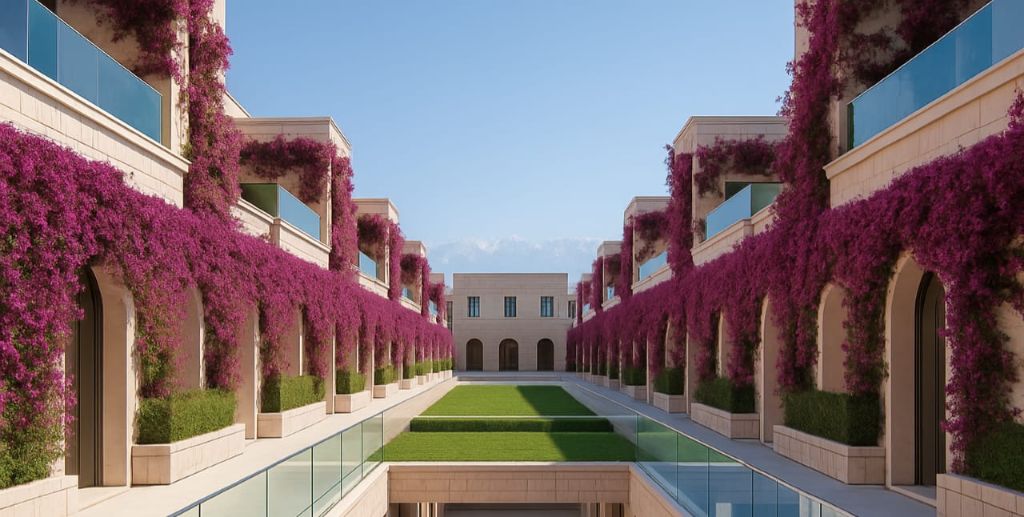
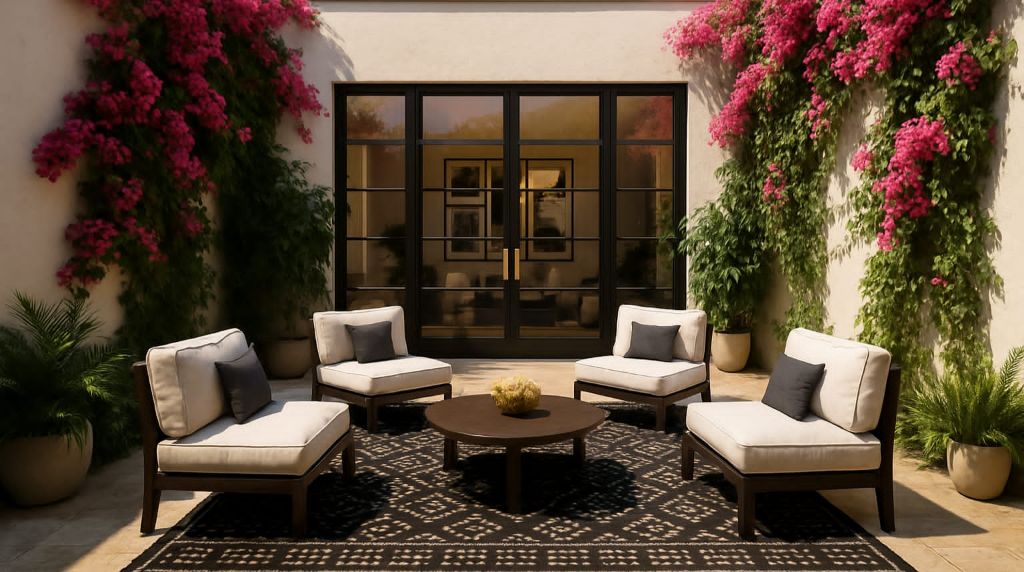
Environmental storytelling: Renderings that invite the family into the frame.
Photography direction was critical. Real estate photography defaults to two modes: empty architectural shots (which feel cold) or staged lifestyle photos with models (which feel fake). We defined a third approach for YASHUDD: environmental storytelling. Each image shows a real space in use — a parent on a video call with a child's drawing visible on the wall behind them; a learning nook with books and a tablet and natural light; a communal courtyard at golden hour with families in unposed proximity. The goal is to make the viewer insert themselves into the image, not admire it from a distance. Every photograph answers the implicit question: could my family live here?
Brand guidelines. A 30+ page system covering logo usage, color specifications, typography hierarchy, photography direction, illustration style, spatial design rules, and tone of voice guidelines. The brand system was designed to work across digital (website, social media, email), print (brochures, investment decks, signage), and physical (on-site wayfinding, unit interiors, community spaces). The intent is that a family encountering YASHUDD on Instagram in Berlin should have an identical brand experience to a family walking through the model unit in Marrakech.
Website architecture. The site was designed as a narrative experience, not a property listing. The homepage does not open with a building render. It opens with the question: What if your home was designed for the way you actually live? The visitor journey flows from the emotional promise (belonging, intentionality, community) to the functional proof (floor plans, workspaces, connectivity specs, community programming) to the conversion pathway (schedule a tour, join the interest list, download the deck). Every page is structured to address the digital family's hierarchy of concerns: first, do I belong here? Then, does it work for my family? Then, how do I make it happen? See how we engineer first impressions here.
Messaging architecture. We developed a messaging framework across six layers: the category-level narrative ("The world changed. Real estate didn't. Until now."), the brand promise ("Home, redesigned for the family that works from anywhere."), the audience mirror ("You didn't give up stability. You redefined it."), the product story (the physical design and its rationale), the location anchor (why Marrakech — cost, climate, culture, connectivity, community), and the community vision (what it means to live among families who have made the same choice). Each layer has its own set of proof points and is calibrated for different touchpoints: the website uses the full cascade; Instagram uses the emotional layers; the investor deck leads with the market and category layers; email nurture sequences use the audience mirror and product story.
Why Marrakech
The location is not incidental to the brand strategy. It is central.
Marrakech offers a combination of attributes that almost no other city in the world matches for the digital family profile. Cost of living is dramatically lower than European or North American equivalents — a family can live comfortably on $1,200–$2,500 per month, including accommodation, food, and activities. The climate is warm for the majority of the year, with over 300 days of sunshine. Cultural richness is unparalleled: Marrakech offers a living immersion in language, history, art, and craft that no European suburb can replicate. Fiber internet is available and expanding. The airport connects to major European hubs in three to four hours. And Morocco, while not yet offering a dedicated digital nomad visa, allows visa-free stays of up to 90 days for most Western nationals, with residence visas available for longer-term stays.
Critically, Marrakech is experiencing a moment of international attention. Foreign investment in Moroccan real estate surged 55% between 2024 and 2025. Luxury property sales are up over 12% year-over-year. The city is transitioning in global perception from "exotic holiday destination" to "serious lifestyle and investment market." YASHUDD positions itself at the leading edge of that transition, not as a vacation property, but as the residential infrastructure for a new kind of resident.
The brand uses Marrakech as a strategic proof point, not just a geographical fact. The messaging frames the city as a deliberate, intelligent choice: "You could live anywhere. Here's why the smartest families are choosing here."
What Adaptive Residential Actually Looks Like
The brand system is only credible if the physical product delivers on the promise. The architectural brief, informed by the brand strategy, specifies five non-negotiable design principles that distinguish YASHUDD from every conventional development in the market.
- The integrated workspace. Every unit includes a dedicated, acoustically designed home office with fiber connectivity, professional lighting, and enough separation from living areas that a parent can take a client call while a child plays in the next room. This is not a desk in a corner. It is a room designed for the job. Gensler's research found that only 10% of multifamily residents had access to a dedicated office space, yet 73% felt their residence could be improved for remote work. YASHUDD closes that gap by designing the workspace in from the beginning, not retrofitting it as an afterthought.
- The learning environment. Each unit includes a children's learning zone — a designated space with natural light, adjustable surfaces, storage for materials, and connectivity for online school sessions. Communal learning spaces supplement the private ones, offering workshop rooms, a library, and outdoor learning areas designed for worldschooling families who want their children to have both structure and freedom.
-
The adaptive floor plan. Units are designed with movable partitions and modular furniture systems that allow families to reconfigure their space as their needs change. A family with an infant needs a different layout than a family with two teenagers. A family that hosts grandparents for a month needs a different configuration than a family of four. Adaptive Residential means the home adapts to the family, not the reverse.
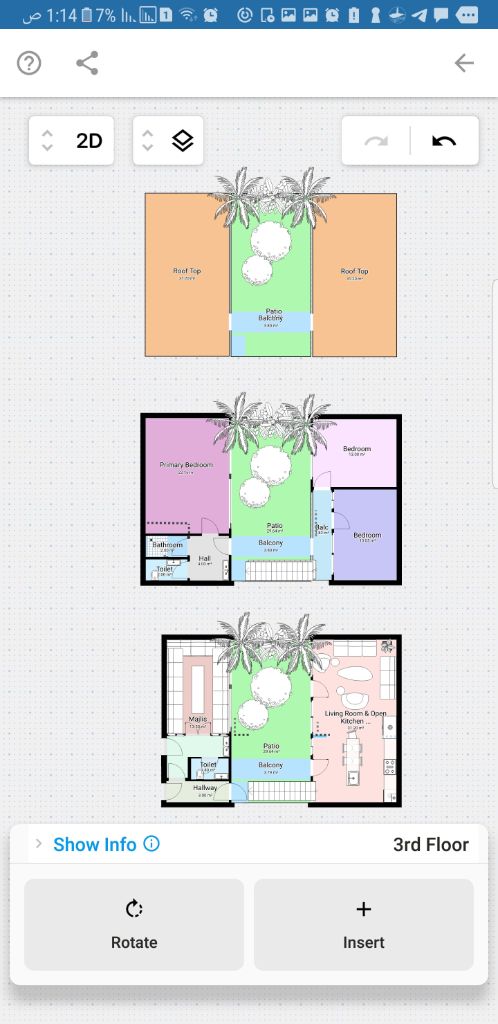
Level 3 Configuration
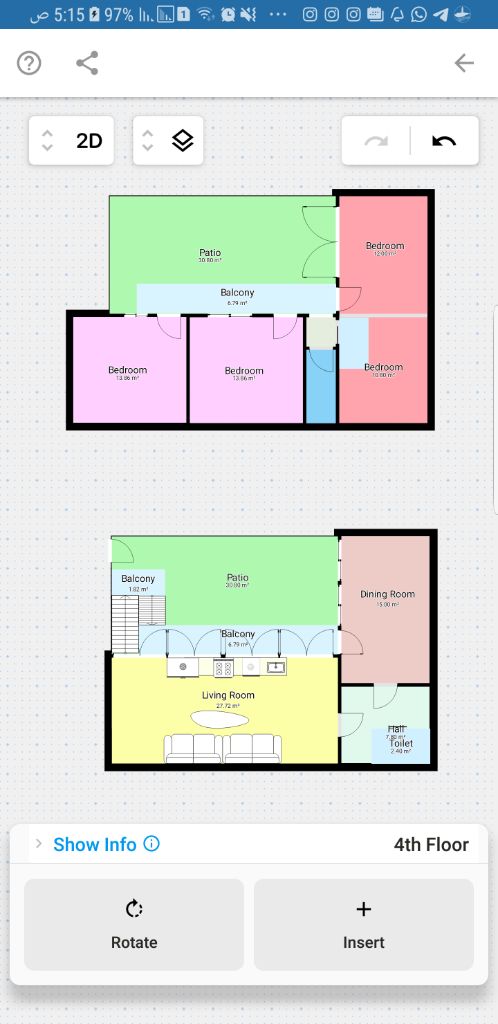
Level 4 Configuration
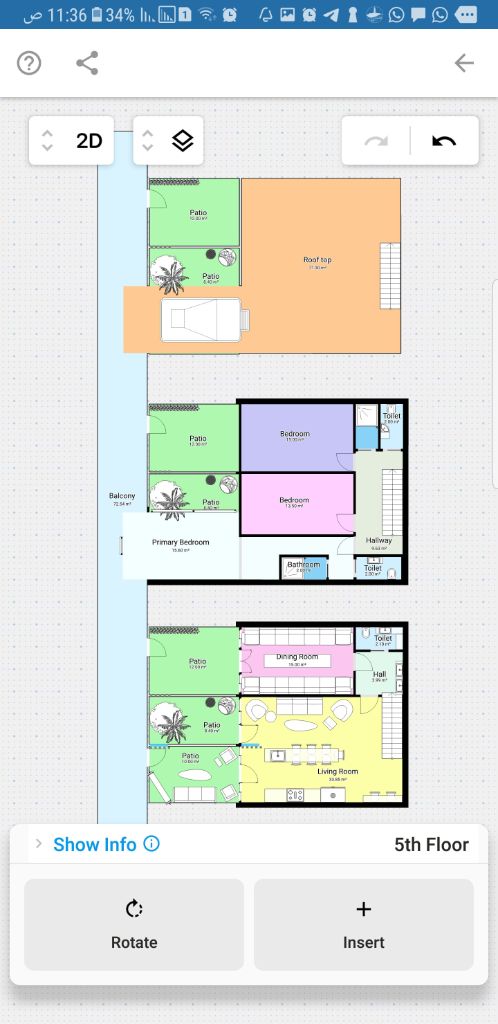
Level 5 Configuration
- The community infrastructure. YASHUDD is not a collection of independent units. It is a residential community with shared amenities designed for digital families: a co-working lounge for days when the home office feels too isolated, a children's activity space with supervised programming, a communal kitchen and dining area for community meals, outdoor courtyards designed for family gathering, and event spaces for workshops, screenings, and social programming. The intent is that to solve the isolation problem that digital nomad families consistently cite as their primary lifestyle pain point.
- Embedded connectivity. Fiber to every unit. Mesh Wi-Fi across all communal spaces. Backup connectivity systems. Smart home integration for lighting, climate, and security. Connectivity is not a feature. It is infrastructure — as fundamental as plumbing. For a family whose income depends on a stable internet connection, anything less than enterprise-grade reliability is unacceptable.
The Results (To Date)
YASHUDD is in its pre-launch phase. The brand system has been delivered. The website is live. The interest list is open. The architectural plans are in development. Unlike Xquisite Morocco, where the case study tracks post-launch revenue performance, YASHUDD's measurable outcomes are currently brand-stage metrics.
What we can document: the brand positioning created immediate market clarity — in conversations with potential buyers, the phrase "adaptive residential for digital families" produces instant recognition, zero confusion, and a self-qualification response ("that's exactly what we've been looking for" or "that's not for us"). The brand eliminates wasted time on unqualified prospects and accelerates trust with qualified ones. Early investor conversations have been characterized by rapid comprehension of the market thesis, directly attributable to the positioning work — investors can explain the opportunity in one sentence, which means the brand is doing its job.
The real test will be sales velocity, pricing power, and community fill rate once units are available. But the brand infrastructure is in place to ensure that when the product is ready, the market already understands what it is, who it's for, and why it exists.
What This Means for Your Brand
YASHUDD is a case study in category creation. Whether it's real estate for digital families or privacy-first mental health platforms for the Gulf, the principle is the same: specific needs require specific brands. The product is real estate, but the lesson is universal: when no existing category fits your product, the most valuable investment you can make is in defining and owning a new one.
Category creation requires three things: a market gap that is real and specific (not just "we're different"); a positioning statement that names the category in language the customer immediately understands; and a brand system that makes the category visible, credible, and desirable before the first unit is sold, the first product is shipped, or the first customer walks through the door.
If your product sits in a no-man's-land between existing categories — if customers keep comparing you to things you're not, if your pricing feels unjustified because the market has no reference point, if your marketing is exhausting because you're constantly explaining what you are — you don't have a marketing problem. You have a category problem. And the fix is not more advertising. It is positioning work that creates the category your product deserves to own.
We can tell you in 90 seconds whether your brand has the strategic infrastructure to own its category — or whether it's still trapped in someone else's.
GET YOUR SCORE
Get Your Remarkability Score
Seven questions across four dimensions: Visual Identity, Strategic Positioning, Customer Experience, and Category Ownership. Ninety seconds. No email required.
Free · 90 seconds · No email to start · 3 of 5 Q2 spots remaining